
Explore Psyllium
See how this form is used, what to look for on the label, and where to find it.

Psyllium forms a gel with water. It can soften stool, help with regularity and modestly lower LDL cholesterol when used regularly. Take it with the amount of fluid specified on the label. [1]
Form details
See how this ingredient works with other supplements
Product-label examples help you compare available strengths. The appropriate daily amount depends on your needs; formulations and availability vary by country.
Psyllium — Husk Fiber
Bulk-forming soluble fiber
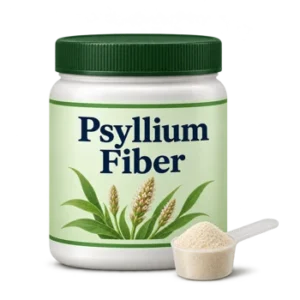
Representative illustration. Product appearance varies.
Other SupplementCommon Uses
Constipation: A gel-forming soluble fiber that absorbs water, softens stool and supports regular bowel movements.
Cholesterol: Regular use can modestly lower LDL and total cholesterol alongside an appropriate diet.
Practical role: Useful when food alone does not provide enough fiber. Take with sufficient fluid; increasing gradually can improve tolerance.
Limits: The cholesterol benefit does not replace prescribed treatment, and psyllium is not a quick weight-loss product.
Sources: MedlinePlus: psyllium · Lipid trials review
Common OTC Strengths
9 g psyllium powder supplies 7 g fiber in a checked serving.
Label sources: 1
Read the grams of fiber per serving and the mixing directions for how much water to use. A scoop of powder can weigh more than the fiber it supplies.
No general maximum is stated for this preparation. Check its specific safety guidance below.
* See additional info below: Psyllium — Husk Fiber safety details. Upper limits are safety ceilings, not intake targets. Age and health conditions affect suitability.
How and Safety
Psyllium absorbs water in the intestines and swells into a bulky mass. This adds bulk to stool and helps it pass more easily, supporting relief from constipation. [1]
Mix each powder dose with at least 8 oz (240 mL) of fluid and drink promptly; follow the product directions. [2]
Mix powder or granules immediately before use and take with at least 240 mL (8 oz) liquid. Follow the product directions; never swallow dry powder. [1]
Never swallow the powder dry. Ask a pharmacist how far to separate it from your medicines. [2]
Trusted Sources
Simple tests to be certain of your individual needs.
Coming soon
Additional Ingredient Information: Safety & Toxicity, Timing & Method
Common Uses & Evidence
Psyllium absorbs fluid and adds stool bulk. MedlinePlus directs at least 240 mL of liquid with a dose; follow the specific product instructions. [1]
Taking supplements together
References
Form Type
Bulk-forming soluble fiber
Bioavailability & Absorption
Acts in the intestine; maximizing blood absorption is not relevant.
Timing & Method
Mix powder or granules immediately before use and take with at least 240 mL (8 oz) liquid. Follow the product directions; never swallow dry powder. [1]
Interactions
Separate psyllium from digoxin, aspirin/salicylates and nitrofurantoin by at least three hours. Ask a pharmacist about spacing other oral medicines. [1]
Safety & Toxicity
Swallowing problems or intestinal blockage require medical advice before use. Seek urgent help for breathing or swallowing difficulty. For self-treatment of constipation, consult a clinician if use is needed beyond one week. [1]
How and Safety — Details & Sources
The mechanism describes how an ingredient could work. Human studies can tell us which benefits people experience with a particular preparation.
Read the Safety & Toxicity and Interactions sections, where available, for further precautions. The preparation and other ingredients matter.
How and Safety — Sources
Further Form Considerations
Swallowing problems or suspected blockage require medical advice. Check medicine spacing and take with the label-directed amount of fluid.
Safety sources: 1
Psyllium — common questions
What is Psyllium commonly used for?
Constipation: A gel-forming soluble fiber that absorbs water, softens stool and supports regular bowel movements.
Cholesterol: Regular use can modestly lower LDL and total cholesterol alongside an appropriate diet.
Practical role: Useful when food alone does not provide enough fiber. Take with sufficient fluid; increasing gradually can improve tolerance.
Limits: The cholesterol benefit does not replace prescribed treatment, and psyllium is not a quick weight-loss product.
Sources: MedlinePlus: psyllium · Lipid trials review
How well is Psyllium absorbed?
Acts in the intestine; maximizing blood absorption is not relevant.
What should I look for on the label for Psyllium?
Read the grams of fiber per serving and the mixing directions for how much water to use. A scoop of powder can weigh more than the fiber it supplies.
When and how is Psyllium usually taken?
Mix powder or granules immediately before use and take with at least 240 mL (8 oz) liquid. Follow the product directions; never swallow dry powder. [1]
Which medicines or supplements can interact with Psyllium?
Separate psyllium from digoxin, aspirin/salicylates and nitrofurantoin by at least three hours. Ask a pharmacist about spacing other oral medicines. [1]
What should I know about combining Psyllium with other supplements?
About Psyllium: intake, safety and evidence
Preparation notes
Husk powders, granules, capsules and wafers.
Upper Limit and Toxicity
Take with adequate liquid. Swallowing difficulty or intestinal blockage needs medical assessment. Do not use longer than one week for constipation without medical advice. [1]