
Explore Creatine
See how this form is used, what to look for on the label, and where to find it.
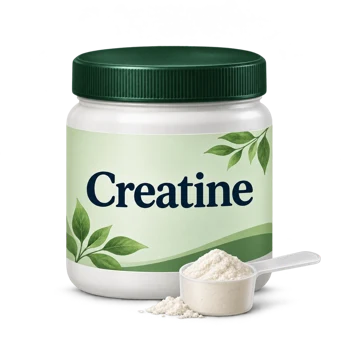
Creatine helps muscles replenish energy for repeated short, intense efforts. Creatine monohydrate is the best-studied preparation for strength training. [2]
See how this ingredient works with other supplements
Product-label examples help you compare available strengths. The appropriate daily amount depends on your needs; formulations and availability vary by country.
Creatine Monohydrate
Sports nutrition compound
Representative illustration. Product appearance varies.
Other SupplementCommon Uses
Strength and power: Helps repeated short, intense efforts and can improve strength and lean-mass gains with resistance training.
Muscle support with aging: Useful alongside strength training, with adequate protein supporting your training goals.
Cognitive research: Trials suggest possible memory benefits, but broader cognitive improvement and dementia prevention are not established.
How it works: Replenishes the muscle's rapid energy reserve. It is not a stimulant and is less useful for prolonged endurance exercise.
Sources: NIH ODS: exercise · Cognition review
Common OTC Strengths
Find creatine monohydrate in Supplement Facts and read its grams per serving. In flavored products, the weight of the entire scoop also includes the other ingredients.
No general maximum is stated for this preparation. Check its specific safety guidance below.
* See additional info below: Creatine Monohydrate safety details. Upper limits are safety ceilings, not intake targets. Age and health conditions affect suitability.
How and Safety
Creatine increases muscle stores of phosphocreatine, which helps rapidly regenerate the energy molecule ATP. This supports repeated short bursts of demanding exercise and can improve training gains over time. [1]
Check blend ingredients: stimulant-containing pre-workouts have additional considerations beyond plain creatine. [2]
Trusted Sources
Simple tests to be certain of your individual needs.
Coming soon
Additional Ingredient Information: Common or Studied Dosage, Safety & Toxicity
Common Uses & Evidence
Evidence is stronger for intermittent intense activity than for endurance. [1]
Taking supplements together
Protein and creatine retention
References
Form Type
Sports nutrition compound
Bioavailability & Absorption
No evidence-based comparative absorption score assigned.
Common or Studied Dosage
Common maintenance amount: 3–5 g/day in adult exercise protocols. Some protocols first use 20 g/day in divided portions for 5–7 days. [2]
Interactions
Evidence on combining creatine and caffeine is mixed. Mayo Clinic notes that caffeine might reduce creatine’s effect, but more research is needed; this should not be presented as a proven dangerous interaction for everyone. People with Parkinson’s disease should discuss the combination with their treating team because findings from that population raise a separate concern. [3]
Safety & Toxicity
Water-related weight gain is common. Medical conditions and long-term use require an individual assessment. [2]
How and Safety — Details & Sources
The mechanism describes how an ingredient could work. Human studies can tell us which benefits people experience with a particular preparation.
Read the Safety & Toxicity and Interactions sections, where available, for further precautions. The preparation and other ingredients matter.
How and Safety — Sources
Creatine — common questions
Is creatine useful for adults over 50 and older adults?
Creatine monohydrate can be a useful addition to resistance training in later life. Trials in older adults have found additional gains in some strength measures and lean mass, although results vary. The strongest practical case is to pair it with regular strength exercise; age over 50 alone does not mean everyone needs it, and it is not a substitute for training, adequate food or protein.
A commonly used adult maintenance amount is 3–5 g of creatine monohydrate daily. A loading phase is optional; taking a daily amount without loading builds stores more gradually. Monohydrate is the most studied form, and more expensive alternatives have not established superior results. Some early weight gain reflects water retention. People with kidney disease or complex medical treatment should discuss use with their clinician.
Sources: Randomized trial in adults over 65 · NIH ODS — creatine protocols and forms
Why does this guide feature creatine monohydrate?
Creatine monohydrate is the most widely used and studied form. Research supports its role in repeated high-intensity activity and resistance training; more expensive forms have not consistently demonstrated an advantage. NIH ODS ↗
Is creatine a stimulant?
Creatine helps replenish phosphocreatine, part of the muscle’s rapid energy system. It is not a stimulant. A pre-workout blend may contain separate stimulants, so compare the full ingredient list. NIH ODS ↗
Where can I compare amounts and trusted sources?
The creatine row lists common OTC strengths, label references and practical guidance. Where to Buy links match the ingredient form; check the selected product’s current amount and directions before purchasing.
What is Creatine commonly used for?
Strength and power: Helps repeated short, intense efforts and can improve strength and lean-mass gains with resistance training.
Muscle support with aging: Useful alongside strength training, with adequate protein supporting your training goals.
Cognitive research: Trials suggest possible memory benefits, but broader cognitive improvement and dementia prevention are not established.
How it works: Replenishes the muscle's rapid energy reserve. It is not a stimulant and is less useful for prolonged endurance exercise.
Sources: NIH ODS: exercise · Cognition review
How well is Creatine absorbed?
No evidence-based comparative absorption score assigned.
What should I look for on the label for Creatine?
Find creatine monohydrate in Supplement Facts and read its grams per serving. In flavored products, the weight of the entire scoop also includes the other ingredients.
Which medicines or supplements can interact with Creatine?
Evidence on combining creatine and caffeine is mixed. Mayo Clinic notes that caffeine might reduce creatine’s effect, but more research is needed; this should not be presented as a proven dangerous interaction for everyone. People with Parkinson’s disease should discuss the combination with their treating team because findings from that population raise a separate concern. [3]
Who should take extra care with Creatine?
Water-related weight gain is common. Medical conditions and long-term use require an individual assessment. [2]
How does Creatine work?
Creatine increases muscle stores of phosphocreatine, which helps rapidly regenerate the energy molecule ATP. This supports repeated short bursts of demanding exercise and can improve training gains over time. [1]
What should I know about combining Creatine with other supplements?
Additional ingredient information
Preparation notes
Creatine monohydrate is the most studied form.
Upper Limit and Toxicity
Water-weight gain and gastrointestinal symptoms can occur. [1]