
Explore BCAA Blends
See how this form is used, what to look for on the label, and where to find it.
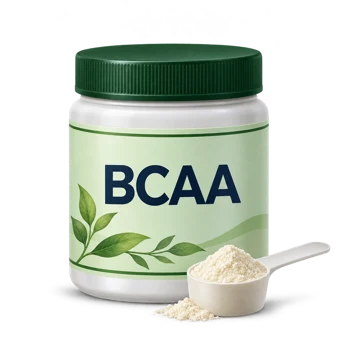
BCAA blends supply leucine, isoleucine and valine. These amino acids are used by muscles, and some exercise trials report less post-workout soreness. [1]
See how this ingredient works with other supplements
Product-label examples help you compare available strengths. The appropriate daily amount depends on your needs; formulations and availability vary by country.
BCAA — Leucine, Isoleucine and Valine Blend
Essential amino-acid blend
Representative illustration. Product appearance varies.
Amino AcidCommon Uses
Training and recovery: Provides leucine, isoleucine and valine, three amino acids used in muscle metabolism.
Muscle soreness: Some trials find less soreness after resistance exercise; benefits are inconsistent in endurance sports.
Muscle building: BCAAs can trigger anabolic signals but do not supply all nine essential amino acids needed to sustain protein synthesis.
Choosing protein support: Complete protein or a full EAA blend provides a more complete amino-acid supply; extra BCAAs have not consistently improved performance when protein intake is adequate.
Sources: BCAA trials review · ISSN: essential amino acids
Common OTC Strengths
5 g total BCAAs per serving in a checked powder.
Label sources: 1
Read the amounts of leucine, isoleucine and valine per serving. A ratio tells you their proportions. Check the rest of the label for added stimulants.
No general maximum is stated for this preparation. Check its specific safety guidance below.
* See additional info below: BCAA — Leucine, Isoleucine and Valine Blend safety details. Upper limits are safety ceilings, not intake targets. Age and health conditions affect suitability.
How and Safety
BCAAs supply leucine, isoleucine and valine; leucine helps signal muscle protein synthesis. Building new muscle still requires the other essential amino acids, so BCAAs alone cannot replace complete protein. [1]
Count their contribution alongside food and other amino-acid products; mix powder as the label directs. [5]
Use BCAAs alongside a diet that supplies complete protein and balanced meals. [2]
Trusted Sources
Simple tests to be certain of your individual needs.
Coming soon
Additional Ingredient Information: Common or Studied Dosage, Safety & Toxicity
Common Uses & Evidence
BCAAs supply three essential amino acids. Research explores soreness and recovery, but results do not establish that every blend improves outcomes beyond adequate high-quality protein intake. [2][3]
Taking supplements together
Complete protein and amino acid blends
References
Form Type
Essential amino-acid blend
Bioavailability & Absorption
No supported dot ranking between commercial BCAA ratios or delivery formats is assigned.
Common or Studied Dosage
Studied supplemental amounts: protocols vary by training context and body size. Upper limit: no general established UL. A precise common amount needs further product and study review. [1]
Interactions
Review the full blend and any added stimulants or botanicals; ingredient combinations require their own assessment. [1]
Safety & Toxicity
Evidence on a short studied protocol does not establish long-term safety for every commercial blend. Special medical circumstances require individual review. [1]
How and Safety — Details & Sources
The mechanism describes how an ingredient could work. Human studies can tell us which benefits people experience with a particular preparation.
Read the Safety & Toxicity and Interactions sections, where available, for further precautions. The preparation and other ingredients matter.
How and Safety — Sources
- Research reference — BCAA Blends: mechanism and clinical context
- NIH ODS — Exercise and Athletic Performance
- NIH ODS — Exercise and Athletic Performance: Consumer
- Martinho et al. 2022 — BCAA Supplementation in Athletes: Systematic Review
- Product label example — follow directions for your own preparation
BCAA Blends — common questions
What is BCAA Blends commonly used for?
Training and recovery: Provides leucine, isoleucine and valine, three amino acids used in muscle metabolism.
Muscle soreness: Some trials find less soreness after resistance exercise; benefits are inconsistent in endurance sports.
Muscle building: BCAAs can trigger anabolic signals but do not supply all nine essential amino acids needed to sustain protein synthesis.
Choosing protein support: Complete protein or a full EAA blend provides a more complete amino-acid supply; extra BCAAs have not consistently improved performance when protein intake is adequate.
Sources: BCAA trials review · ISSN: essential amino acids
How well is BCAA Blends absorbed?
No supported dot ranking between commercial BCAA ratios or delivery formats is assigned.
What should I look for on the label for BCAA Blends?
Read the amounts of leucine, isoleucine and valine per serving. A ratio tells you their proportions. Check the rest of the label for added stimulants.
Which medicines or supplements can interact with BCAA Blends?
Review the full blend and any added stimulants or botanicals; ingredient combinations require their own assessment. [1]
Who should take extra care with BCAA Blends?
Evidence on a short studied protocol does not establish long-term safety for every commercial blend. Special medical circumstances require individual review. [1]
What should I know about combining BCAA Blends with other supplements?
Additional ingredient information
Common Uses
Training, muscle recovery and soreness often taken before, during and immediately after exercise are common reasons for use. A complete protein (whey, other) provides more critical amino acids and can result in better muscle development but is slower to metabolize. (See EAA's). Research findings vary by context. [2][3]