
Explore D-Mannose
See how this form is used, what to look for on the label, and where to find it.
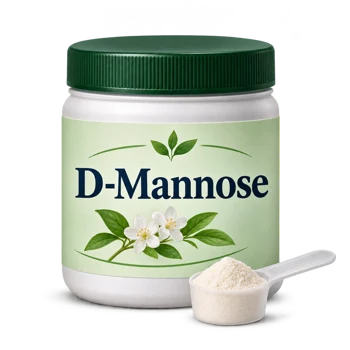
D-mannose is commonly used in hopes of preventing repeat urinary tract infections. A large trial in women in primary care found similar recurrence with D-mannose and placebo. New urinary symptoms need an assessment for active infection. Sources: Randomized trial · Trials review
See how this ingredient works with other supplements
Product-label examples help you compare available strengths. The appropriate daily amount depends on your needs; formulations and availability vary by country.
D-Mannose — Preparation Overview
Supplement preparation
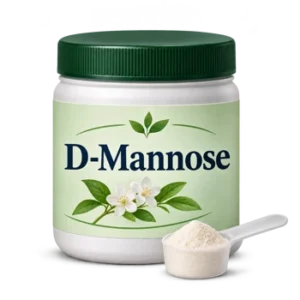
Representative illustration. Product appearance varies.
Other SupplementCommon Uses
Recurrent UTI interest: Used in an attempt to prevent repeated urinary tract infections.
Current evidence: A large placebo-controlled trial in women and a later review did not find reliable prevention benefit.
Proposed mechanism: May interfere with attachment of certain bacteria to the urinary tract, but a plausible mechanism is not proof of effectiveness.
Treatment distinction: It is not a treatment for an active infection. New urinary symptoms require assessment rather than relying on D-mannose.
Sources: Randomized trial · Trials review
Common OTC Strengths
500 mg D-mannose in a verified product example.
Label sources: 1
Read the amount of D-mannose per serving and check for added cranberry or other ingredients. For powders, check the sugar content too.
No general maximum is stated for this preparation. Check its specific safety guidance below.
* See additional info below: D-Mannose — Preparation Overview safety details. Upper limits are safety ceilings, not intake targets. Age and health conditions affect suitability.
How and Safety
D-mannose may interfere with certain E. coli bacteria attaching to the urinary tract. Despite that plausible mechanism, a large trial did not show prevention of recurrent UTIs in women in primary care. [1]
Follow directions if using it after clinical discussion; mix powder with the specified fluid. [4]
Do not use it instead of assessment and treatment for an active urinary infection. [1]
Trusted Sources
Simple tests to be certain of your individual needs.
Coming soon
Additional Ingredient Information: Common or Studied Dosage, Safety & Toxicity
Common Uses & Evidence
A large 2024 primary-care trial did not show a reduction in medically attended recurrent UTI with daily D-mannose. It should not replace assessment or treatment of an existing infection. [1]
Taking supplements together
References
Form Type
Supplement preparation
Bioavailability & Absorption
A comparative absorption score is not assigned to this broad preparation overview.
Common or Studied Dosage
Studied amount, not an established recommendation: A large UK trial tested 2 g/day for six months in women with recurrent urinary tract infections. It did not show a meaningful reduction in infections compared with placebo. This amount should therefore not be presented as a proven preventive dose. [2]
Safety & Toxicity
D-mannose products can add sugar to your intake; check the complete formulation. Discuss use during pregnancy with your clinician. Suspected urinary infection needs appropriate assessment and treatment rather than reliance on a supplement. [3]
How and Safety — Details & Sources
The mechanism describes how an ingredient could work. Human studies can tell us which benefits people experience with a particular preparation.
Read the Safety & Toxicity and Interactions sections, where available, for further precautions. The preparation and other ingredients matter.
How and Safety — Sources
D-Mannose — common questions
What is D-Mannose commonly used for?
Recurrent UTI interest: Used in an attempt to prevent repeated urinary tract infections.
Current evidence: A large placebo-controlled trial in women and a later review did not find reliable prevention benefit.
Proposed mechanism: May interfere with attachment of certain bacteria to the urinary tract, but a plausible mechanism is not proof of effectiveness.
Treatment distinction: It is not a treatment for an active infection. New urinary symptoms require assessment rather than relying on D-mannose.
Sources: Randomized trial · Trials review
How well is D-Mannose absorbed?
A comparative absorption score is not assigned to this broad preparation overview.
What should I look for on the label for D-Mannose?
Read the amount of D-mannose per serving and check for added cranberry or other ingredients. For powders, check the sugar content too.
Who should take extra care with D-Mannose?
D-mannose products can add sugar to your intake; check the complete formulation. Discuss use during pregnancy with your clinician. Suspected urinary infection needs appropriate assessment and treatment rather than reliance on a supplement. [3]
How does D-Mannose work?
D-mannose may interfere with certain E. coli bacteria attaching to the urinary tract. Despite that plausible mechanism, a large trial did not show prevention of recurrent UTIs in women in primary care. [1]