
Explore MSM
See how this form is used, what to look for on the label, and where to find it.
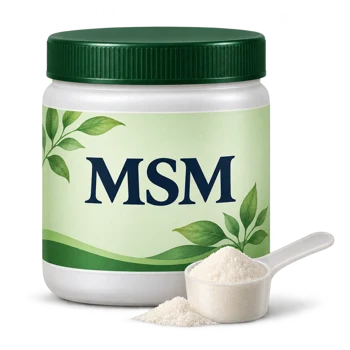
MSM is used for joint pain and stiffness. Small trials in knee osteoarthritis have studied it both on its own and with glucosamine. Sources: NCCIH: MSM
See how this ingredient works with other supplements
Product-label examples help you compare available strengths. The appropriate daily amount depends on your needs; formulations and availability vary by country.
MSM — Preparation Overview
Supplement preparation
Representative illustration. Product appearance varies.
Other SupplementCommon Uses
Joint comfort: Commonly used for osteoarthritis pain and stiffness, often alongside glucosamine or chondroitin.
What research shows: Only a small amount of clinical research is available, so a dependable benefit has not been established.
Ingredient role: MSM is a sulfur-containing compound; being a source of sulfur does not itself demonstrate cartilage repair.
Expectations: It is not proven to rebuild joints or prevent arthritis progression. Claims for a mixture cannot automatically be attributed to MSM alone.
Sources: NCCIH: MSM
Common OTC Strengths
1,000 mg product strength; 2,000 mg in a checked serving.
Label sources: 1
Find methylsulfonylmethane (MSM) and read its own amount per serving. A number for the whole joint blend includes other ingredients.
No general maximum is stated for this preparation. Check its specific safety guidance below.
* See additional info below: MSM — Preparation Overview safety details. Upper limits are safety ceilings, not intake targets. Age and health conditions affect suitability.
How and Safety
Check whether MSM is standalone or part of a joint formula and follow the full product’s directions. [3]
Check for overlapping ingredients when combining joint-support products. [1]
Long-term safety information is limited. Review the whole product, particularly multi-ingredient joint formulas. [1]
Trusted Sources
Simple tests to be certain of your individual needs.
Coming soon
Additional Ingredient Information: Safety & Toxicity
Common Uses & Evidence
Some people with knee osteoarthritis reported less pain or stiffness in small studies of MSM. The size of the improvement varies across trials. [1]
Taking supplements together
References
Form Type
Supplement preparation
Bioavailability & Absorption
A comparative absorption score is not assigned to this broad preparation overview.
Side Effects
MSM can cause digestive upset, rash or allergic reactions. [1]
Safety & Toxicity
Safety information for MSM remains limited. Its use in joint-health products does not establish a safe dose for every person or for prolonged use. Review the complete product with your clinician, particularly when it combines MSM with other active ingredients. [1]
How and Safety — Details & Sources
The mechanism describes how an ingredient could work. Human studies can tell us which benefits people experience with a particular preparation.
Mechanistic pathways remain largely preclinical; small short-term trials do not establish structural joint repair.
Read the Safety & Toxicity and Interactions sections, where available, for further precautions. The preparation and other ingredients matter.
How and Safety — Sources
Further Form Considerations
Long-term safety information is limited. Review the whole product, particularly multi-ingredient joint formulas.
Sources: 1
MSM — common questions
What is MSM commonly used for?
Joint comfort: Commonly used for osteoarthritis pain and stiffness, often alongside glucosamine or chondroitin.
What research shows: Only a small amount of clinical research is available, so a dependable benefit has not been established.
Ingredient role: MSM is a sulfur-containing compound; being a source of sulfur does not itself demonstrate cartilage repair.
Expectations: It is not proven to rebuild joints or prevent arthritis progression. Claims for a mixture cannot automatically be attributed to MSM alone.
Sources: NCCIH: MSM
How well is MSM absorbed?
A comparative absorption score is not assigned to this broad preparation overview.
What should I look for on the label for MSM?
Find methylsulfonylmethane (MSM) and read its own amount per serving. A number for the whole joint blend includes other ingredients.
What side effects can MSM cause?
MSM can cause digestive upset, rash or allergic reactions. [1]
Who should take extra care with MSM?
Safety information for MSM remains limited. Its use in joint-health products does not establish a safe dose for every person or for prolonged use. Review the complete product with your clinician, particularly when it combines MSM with other active ingredients. [1]